

Blog
Bone Density and Menopause: Why Strength Training Matters More Than Ever | Surf Coast
Bone Density and Menopause: Why Strength Training Matters More Than Ever
When we talk about menopause, the conversation often centres on hot flushes, sleep and mood. Those changes are real and they matter. Some of the most important changes, though, are ones you cannot feel: what is happening to your bones and muscles.
The years around your final period are when bone loss is fastest, and when muscle strength becomes harder to hold on to. You will not notice it day to day, and many women only find out years later after a bone density scan or a fracture.
The good news: this is also a window of opportunity. Strength training is one of the most effective things you can do to protect your bones and muscles through menopause and beyond. Here is why it matters more than ever, and how to start safely, even if you have never lifted a weight before.
What happens to your bones around menopause
Oestrogen helps keep the balance between breaking down old bone and building new bone. As oestrogen falls, bone is broken down faster than it is rebuilt.
Bone loss speeds up before your periods stop. A large study that followed women through menopause found bone loss was fastest from about a year before the final period to about two years after it [1].
The first decade matters most. Roughly half of the bone women lose over their lifetime is lost in the first ten years after menopause [2].
The rate can be significant. Bone density may fall by up to around 3% a year in the years around menopause [3].
Every woman is different. Some lose bone quickly through this time and others lose very little [2], which is why you cannot tell from how you feel.
What happens to your muscles
Muscle mass and strength also tend to decline with age, and this appears to coincide with menopause [4]. Muscle mass may fall by around 0.6% a year after menopause [3].
Researchers are still working out exactly how much of this is due to falling hormones and how much to ageing and lifestyle [4]. What is clear is that resistance exercise is the most effective way to counter age-related muscle loss [4].
Bone and muscle work as a team. Muscles pulling on bone help keep it strong, and strong muscles support balance, which lowers your risk of falls and fractures.
Why strength training matters more than ever
Strength training means working your muscles against a load that is genuinely challenging, such as weights, resistance machines or your own body weight, and gradually increasing it over time. Through menopause, it helps in several ways:
Bone. In a 2025 review of exercise trials in women around menopause, strength training improved bone density at every site measured in early postmenopause; walking improved the hip only [5].
Muscle and strength. Resistance training is the most effective way to build and keep muscle as you age [4].
Balance and falls. Stronger legs and better balance mean fewer falls, and fewer falls mean fewer fractures.
Everyday function. Carrying shopping, lifting grandchildren, getting up off the floor, and keeping up with the activities you love.
Confidence. Feeling physically stronger can make you more confident in how you move day to day.
Early research also suggests heavier strength training may help with menopausal symptoms. A small Canadian trial in women around menopause found 9 months of supervised heavy strength and impact training improved muscle mass, strength, spine bone density and menopausal symptoms [6]. It was a small feasibility study, so larger trials are needed, but the results are encouraging.
What about heavier weights? The Australian LIFTMOR trial found that supervised, high-intensity strength and impact training improved bone density at the spine and hip in postmenopausal women who already had low bone mass, with no fractures from the training [7]. Lifting heavier, with good supervision, is safer and more effective than many women have been led to believe.
Why perimenopause is a good time to start
You do not need to wait for a diagnosis. Because bone loss speeds up before your periods stop [1], perimenopause is a good time to build strength, learn good lifting technique and make training a habit.
To be honest about the evidence, there are still only a few exercise trials in perimenopausal women specifically, and they have not yet shown clear changes in bone density at this stage [5]. Starting now still means you go into the years of fastest bone loss with stronger muscles, better balance, and the skills and confidence to keep progressing, and the evidence in early postmenopause is stronger [5].
Common worries, and how we help
"I've never lifted weights before." That is very common. We start where you are, teach technique from the beginning and build up gradually.
"I leak when I jump or lift," or "I'm worried about prolapse." Bladder and pelvic floor changes are common around menopause, and impact exercise can be a problem for women with continence issues [8]. Those changes do not have to stop you exercising. As pelvic health physiotherapists, we assess your pelvic floor and build it into your program, so you can load your body with confidence.
"My joints ache." Joint aches are common in menopause. Strength-based exercise is a key part of supporting healthy joints through menopause [9], and we adapt exercises to what feels right for you.
"I'm worried I'll hurt my back." Good technique and gradual progression are what make lifting safe. In LIFTMOR, supervised training was safe even for women who already had low bone mass [7].
Why physio-led strength training?
An assessment first. We look at your strength, balance, posture, pelvic floor, any pain or past injuries, and your bone density results if you have them.
Pelvic health expertise. All of our physiotherapists hold a Postgraduate Certificate in Pelvic Floor Physiotherapy from the University of Melbourne, so your pelvic floor is part of the plan from day one.
Progressive, bone-targeted programming. Australian guidelines recommend progressive resistance training, impact loading and balance work for bone health [8]. We build up the load gradually so your body adapts safely.
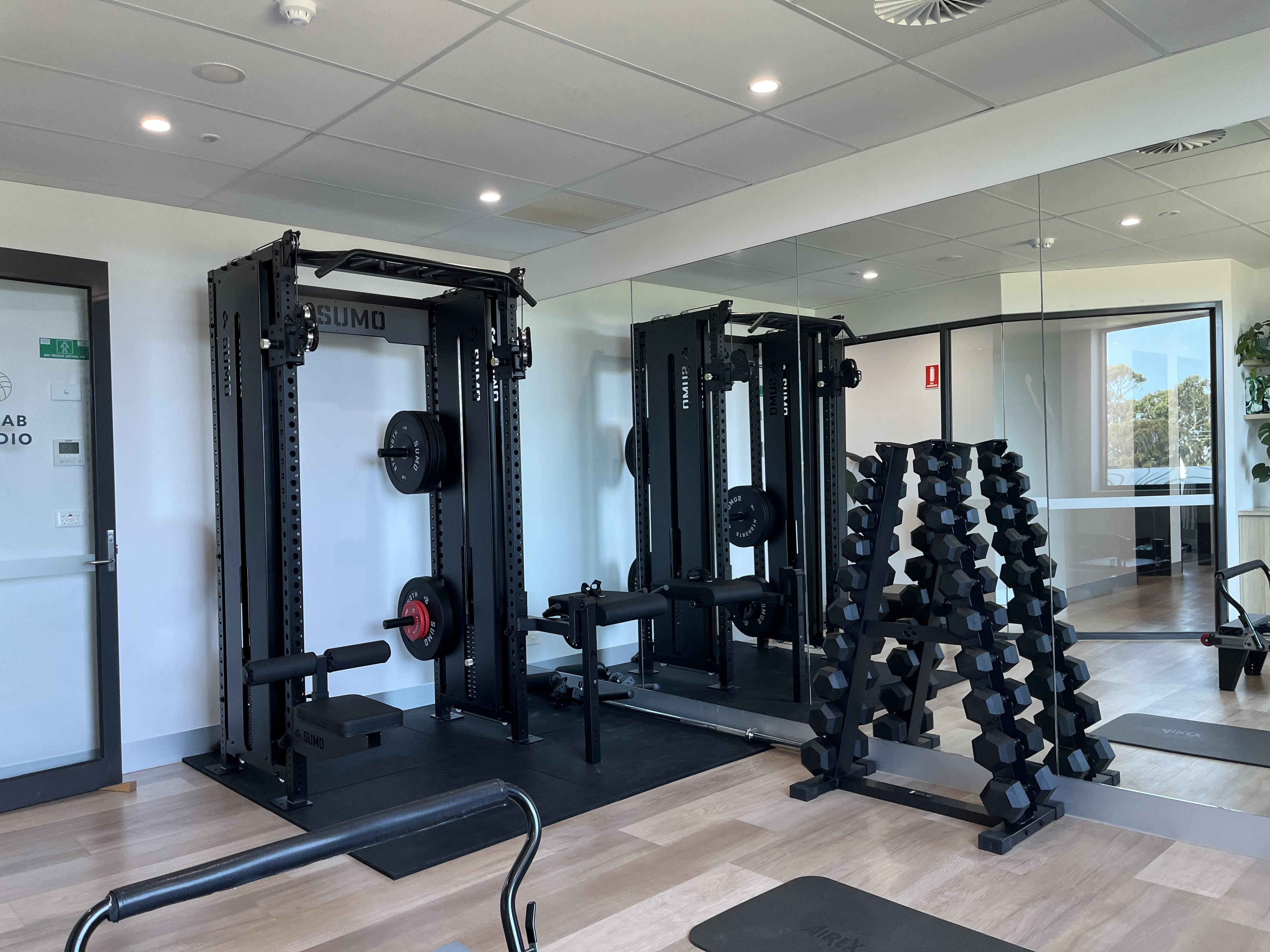
A private studio. Sessions run 1:1 in our Rehab Studio, so you can learn without feeling watched.
Measurable progress. We use a dynamometer, a handheld device that measures muscle force, to test your grip and key muscle groups such as your hips and thighs. Repeating these tests shows how your strength is changing between bone density scans.
A pathway for the long term. Once you are confident, you may continue in 1:1 sessions, move into our 1:4 clinical Pilates classes, or combine the two, depending on your goals.
What we focus on in sessions
Learning to lift with good technique, including squats, deadlifts and presses
Progressive loading that builds over weeks and months
Impact work introduced gradually, when you and your pelvic floor are ready
Back and postural strength
Balance and falls prevention
A home or gym program you can keep doing
Working alongside your GP
Strength training is one part of looking after your bones through menopause. Your GP can talk with you about your fracture risk, whether a bone density scan is appropriate, calcium and vitamin D, and treatment options. These may include menopausal hormone therapy (MHT), which can improve bone density and reduce fracture risk [3], or other medicines where needed.
We are happy to work with your GP and share your strength results with your consent, so your exercise program and your medical care support each other.
Who this is ideal for
Women in perimenopause who want to protect their bones and muscles early
Women in the first years after menopause
Women who have never done strength training and want to learn safely
Women with osteopenia or osteoporosis, or a family history of it
Women whose bladder or pelvic floor symptoms are holding them back from exercise
Our class clients who are ready to add heavier strength work
Take the next step
Menopause is a natural stage of life, and it is also a powerful time to invest in your strength. The work you do now can help you stay strong, steady and active for decades to come.
Book an initial strength training assessment with one of our physiotherapists. If you already come to our classes, ask your physio whether strength training would suit you.
This article is for general education only and is not a substitute for personalised medical advice. Speak with your GP about your bone health, menopause and any medication.
References
Greendale GA et al. Bone mineral density loss in relation to the final menstrual period in a multiethnic cohort: results from the Study of Women's Health Across the Nation (SWAN). Journal of Bone and Mineral Research, 2012.
Finkelstein JS et al. Bone mineral density changes during the menopause transition in a multiethnic cohort of women. Journal of Clinical Endocrinology and Metabolism, 2008.
Jean Hailes for Women's Health. Menopause and musculoskeletal health (health professional webinar, slides).
Menzies C et al. Menopause, female sex hormones, skeletal muscle mass and muscle protein turnover in humans. Journal of Cachexia, Sarcopenia and Muscle, 2026.
Whitman PW et al. Does exercising during peri- or early post-menopause prevent bone and muscle loss: a systematic review. Bone, 2025.
Whitman PW et al. Preventing muscle and bone loss in peri-menopausal and early post-menopausal females with heavy strength and impact training: the STOP-EM trial. Bone Reports (summary).
Watson SL et al. High-intensity resistance and impact training improves bone mineral density and physical function in postmenopausal women with osteopenia and osteoporosis: the LIFTMOR randomized controlled trial. Journal of Bone and Mineral Research, 2018.
RACGP Handbook of Non-Drug Interventions. Exercise for preventing bone loss and reducing fracture risk.
Bupa (with Jean Hailes endocrinologist Dr Yvonne Chow). Menopause and joint pain.

You Deserve To Feel Good
Surf Coast Physiotherapy and Pilates in Torquay has a range of classes suitable for women of all ages.
To view our class timetable, click the button below.
Contact Us
If you are unable to find a suitable time via our online booking system, please call, or send us an email and we will do our best to accommodate you.
Open Hours
Monday : 09:00 am – 05:00 pm
Tuesday: 09:00 am – 05:00 pm
Wednesday: 09:00 am – 05:00 pm
Thursday: 09:00 am – 03:30 pm
Friday: Closed
Saturday: 8:00 am – 11:00 am (by appt)
Sunday: Closed
Evenings by appointment
Location
Suite 104, First Floor, Torquay Medical Hub
1 Cylinders Drive, Torquay, Victoria 3228
Phone Number
0421248853

Acknowledgement to Country
Surf Coast Shire spans the traditional lands of the Wadawurrung and Eastern Maar people. We acknowledge them as the Traditional Owners and Protectors of this place. We acknowledge their ancestors who cared for the land, rivers and sea - and all of its creatures - for thousands of generations. We pay our respects to elders past, present and future who continue on this path.
Copyright. All rights reserved.